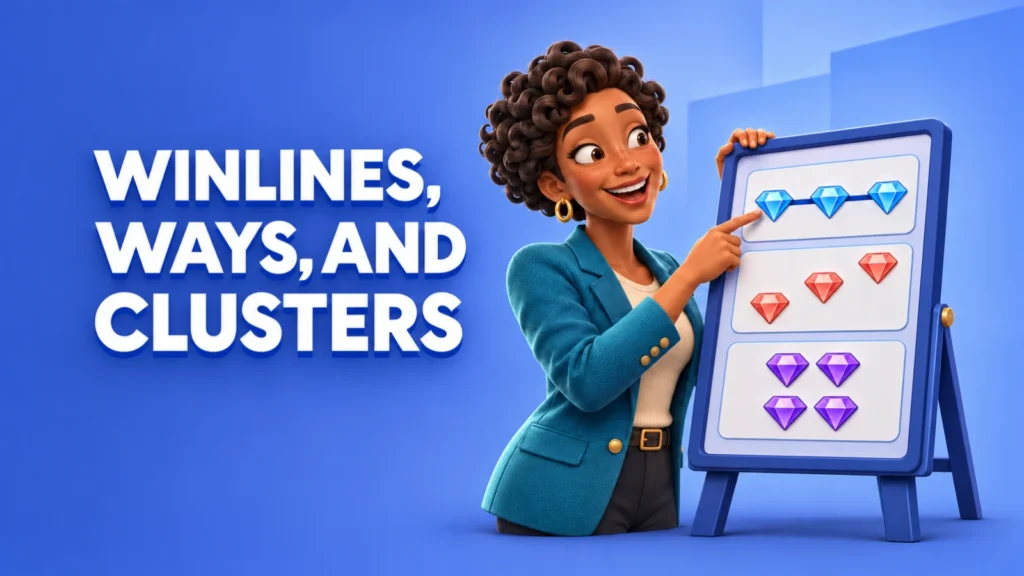
Matching symbols can form very different patterns from one slot to another. A straight row might matter in one game, while another counts combinations across reels or groups of neighboring symbols.
Those differences shape what you look for when the reels stop. Recognizing the pattern first helps you make sense of why one arrangement qualifies and another doesn’t, even when both contain the same number of matching symbols.
This guide compares winlines, ways, and connected clusters using diagrams with letter symbols. Each illustration has its own stated example rule, so you can focus on the pattern without treating it as a particular slot’s rules or awards.
What Is The Difference Between Winlines, Ways, And Clusters?
The difference is which positions may combine. Winlines use defined paths, ways use eligible positions across the required reels, and connected clusters use neighboring symbols. A screen full of the same symbol can still miss if the positions or count fail the applicable rule.
A win system tells you how to recognize a qualifying pattern. The symbol’s win-table entry then supplies the award for that pattern. Keep these two questions separate when comparing games: where do the symbols need to appear, and what does that combination award?
How Do Winlines Count Matching Symbols?
For a winline, trace one active path through the reels. In our three-reel illustration, that path runs straight across the middle row, and all three positions must contain A. The left grid completes that path. In the right grid, the third A sits one row too high, so this line fails.
A winline can also zigzag if the game’s diagram defines that path. Don’t draw a new line between convenient matches. Follow the paths the game actually uses, including its direction and minimum match count.
Active means the game evaluates that path for the spin. Fixed winlines are built into the game, while a game with selectable lines may let you choose which ones are active. A left-to-right rule must begin on the required leftmost reel; three symbols starting farther across the screen do not qualify merely because they line up.
3 Roaring Bells: Hold and Win 3×3 places its base game on three reels and three rows with five fixed winlines. That compact shape makes it easier to compare the reel positions with a line diagram.
How Do Ways To Win Work?
Ways remove the need to follow one fixed row or zigzag. Under a left-to-right consecutive-reel rule, matching symbols can appear at different heights, provided each required reel contributes an eligible match.
Count the matching positions on each required reel, then multiply them: 2 x 1 x 2 = 4 winning ways in this example. Each way chooses one eligible A position from each reel. If the middle reel contains no A, the consecutive sequence breaks, even when more A symbols appear on later reels.
Available ways and winning ways are different counts. An illustrative five-reel layout with three eligible positions per reel has 3 x 3 x 3 x 3 x 3 = 243 available combinations. It does not award 243 wins on every spin. Only combinations that meet the symbol’s matching rule count, and its win-table entry determines the award.
Bonanza uses Megaways, which can change the number of available symbol positions. You can find that style in the SpinBlitz Megaways collection. For any title you open, read how its matching positions and consecutive reels are evaluated.
How Do Cluster Wins Work?
For a connected cluster, start at one matching symbol and follow its eligible neighbors. In our example, five A symbols must connect through shared edges. Horizontal and vertical neighbors connect; a diagonal touch alone doesn’t.
That shared-edge rule belongs to the illustration. Read the game’s own adjacency directions and required count before tracing a real cluster. Some games count matching symbols anywhere instead, without requiring them to connect. Sugar Teddy x1000 is an anywhere-count example, so scattered candies should not be treated as a connected-cluster demonstration.
For this diagram, count each connected A position once. Two separate groups of three would not combine into a qualifying group of six, because the example requires one connected group of at least five. A diagonal-only touch also leaves the groups separate. Another game may set a different minimum or allow different connections.
For a connected-grid game to compare, Wizzy Trix uses a seven-by-seven layout. The letter diagram here isolates the connection rule on a smaller grid, so you can practice tracing neighbors before reading a busier game screen.
When a result is unclear, identify the pattern the game uses:
- Winline: Trace an active path through the reels.
- Ways: Combine eligible matching positions across the required consecutive reels.
- Connected cluster: Count matching neighbors under the game’s adjacency rule.
Once you’ve identified that rule, the same visible symbols become much easier to explain.
What Other Win Rules And Features Can You Compare?
An anywhere-count rule is another alternative to connected clusters. In Sugar Teddy x1000, eight or more identical candies can count even when they do not touch. Check whether a guide or game describes a connected group or simply a total number of matches anywhere.
Cascading reels describe what happens after a win: symbols clear and the changed grid is checked again. They can accompany different win systems. Likewise, a Hold and Win feature changes the bonus-round behavior rather than replacing every ordinary win rule. Identify the pattern first, then follow the feature.
Which Win Pattern Will You Try At SpinBlitz?
Tracing a winline, combining ways, or counting connected neighbors gives you three different ways to read the reels. Choose the pattern you want to try next, then join SpinBlitz for slots and other social casino games.