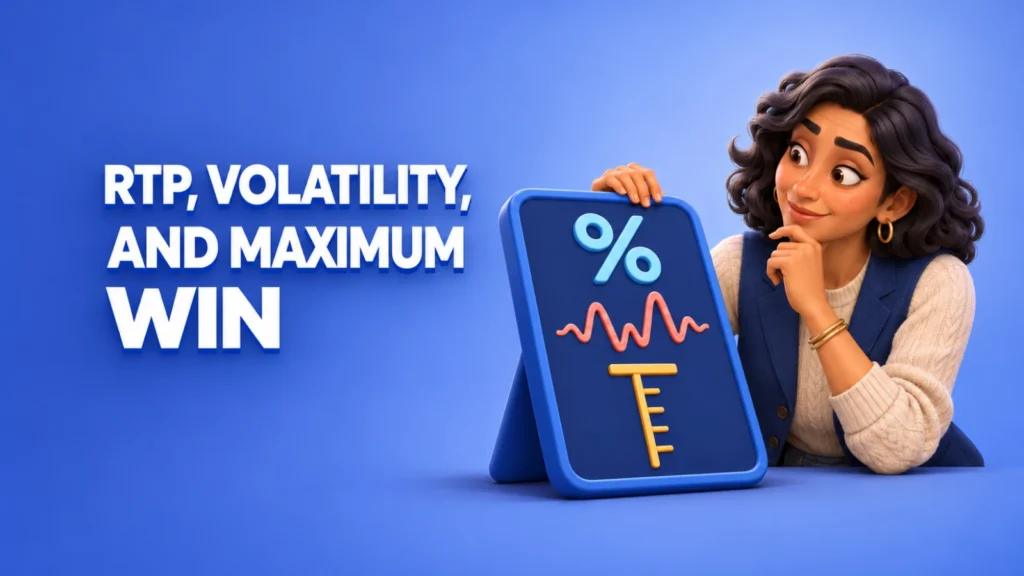
A slot’s information panel can put several headline figures side by side. RTP, volatility, and maximum win all describe the game, but each answers a different question about its design.
Keeping those questions separate makes comparisons more useful. A long-run percentage, a description of how results vary, and an upper award limit don’t become interchangeable just because they appear in the same panel.
This guide explains how to read each label, check its units and scope, and use the information for the game configuration and coin mode you’re viewing. The example panel uses hypothetical figures throughout, rather than SpinBlitz game settings.
What Does The RTP Percentage Describe?
RTP means return to player. It is the theoretical ratio of awards to the amounts used for play across the game’s long-run outcome model. In the illustration, 96% describes that overall relationship. It isn’t the percentage of spins that win.
The percentage also doesn’t divide each spin into a returned portion and a lost portion. One spin can award nothing; another can award more than its play amount. The long-run measure includes the mix of outcomes covered by that configuration, such as its ordinary play and included features.
Check the scope beside the figure. Standard play, an optional setting, and a feature-entry option may have separate RTP figures. Read the value for the option you’re actually considering.
What Can The Volatility Label Tell Me?
A volatility classification describes the spread of results. Broadly, lower-volatility games tend toward smaller, more frequent awards, while higher-volatility games tend toward larger swings with more of the return concentrated in less frequent larger outcomes.
The example panel’s High label refers to that profile. The label doesn’t tell you the exact chance of triggering a feature. For that, you’d need separate information about the event’s frequency. Rating scales can also differ between studios, so compare the wording used by each game.
Our slots grouped by volatility provide a route through the available collections. The individual game’s information gives the classification to read alongside its mechanics.
What Is The Maximum Measured Against?
Read both the unit and the covered event. A maximum expressed as 1,000x the total spin amount is a multiple. In the hypothetical panel, a 100 GC spin would have a 100,000 GC round ceiling: 100 x 1,000.
That calculation describes a limit, not a likely award. A number on one multiplier symbol can have a narrower role than the cap for an entire round. Check whether the maximum applies to one spin, a feature, or a complete round including its feature sequence.
Why Can My Session Result Differ From Theoretical RTP?
A small sample records only the outcomes that occurred in those plays. Consider an illustrative 20-spin sample at 100 GC per spin: 2,000 GC used and 1,400 GC awarded. Its observed return is 1,400 / 2,000 x 100 = 70%.
The balance change for that sample is a decrease of 600 GC. Neither the 70% observed result nor the 600 GC difference changes the hypothetical game’s 96% theoretical RTP. They measure one short sample, while theoretical RTP describes the game’s long-run model. The gap doesn’t create an amount owed back on later spins.
Does A Higher RTP Also Mean Lower Volatility?
No. RTP concerns the average return built into the model; volatility concerns the spread around that average. Two games can have the same RTP with different mixes of small, large, and zero awards. A higher RTP alone doesn’t establish a lower volatility rating or a more frequent feature.
Read all three labels on their own terms:
- RTP: Check the percentage and configuration.
- Volatility: Read the classification.
- Maximum win: Check the units and scope.
Then connect them with the win rule and features you can see on the screen.
What Else Helps You Compare Slot Games?
Compare win systems and features alongside the figures. A fixed-winline layout gives you paths to follow, Megaways varies the available ways, and cascading reels can continue a winning sequence. Those labels describe how you read the action, rather than replacing RTP or volatility.
A Hold and Win round offers a different feature structure, with retained symbols and a respin counter. Choose between formats by the play you want to follow, then read each game’s own figures. A shared mechanic or theme does not establish that two games have the same return, volatility, or maximum win.
Ready To Compare Your Next Slot At SpinBlitz?
Reading RTP, volatility, and maximum win separately gives you a clearer starting point for comparing slot details. Join SpinBlitz to choose from our online slots and other social casino games, with each game’s own rules close at hand.